

Stones, Bones and Stars


 |
|---|
 |
 |
 |
 |
 |
 |
 |
 |

The Melbourne Mobile Mini Museum
A wonderful museum incursion experience
Presented by Greg Stewart
[ BA., Dip Ed., Grad Dip Adol Mntl Hlth RCH / Melb ]


Guide. Nurture. Inspire
Stones, Bones and Stars
|
|---|
|
|
|
|
|
|
|
|
The Melbourne Mobile Mini Museum
A wonderful museum incursion experience
Presented by Greg Stewart
[ BA., Dip Ed., Grad Dip Adol Mntl Hlth RCH / Melb ]
Visitors
Guide. Nurture. Inspire
THE STONES BONES AND STARS COLLECTION
This catalogue comprises a selection of some of the wonderful specimens in The Stones, Bones and Stars Collection that young people have the opportunity to examine, talk about, touch and hold.


CATALOGUE OF THE STONES, BONES AND STARS COLLECTION SPECIMENS
* Go to a particular category or specimen by simply clicking on it in the menu below


* This collection catalogue is being continually added to, revised, edited and updated so please excuse any temporary inaccuracies or errors.
OF INTEREST


CRYSTALS AND MINERALS


QUARTZ CRYSTALS

Clear Quartz Crystals
* These specimens found all over the world, including Australia, North America, Brazil and Africa.

A Huge Cloudy Quartz Crystal
* Found in Zambia, Africa.

A Massive 60cm Quartz Crystal
* Found in North America


Himalayan 'Pink' Quartz
Large Clusters of Himalayan ' Pink' Quartz Crystals
* Found in the Kullu Valley India
Phantoms
Enhydros


Phantom Quartz Crystals
With Phantoms inside, covered in Hematite
A unique variety of quartz crystal whose growth is temporarily paused at some stage in its history. During this pause, trace minerals sometimes coat the surface of the crystal ( in our case, it was hematite ) and if the crystal resumes growing at some time, additional layers of quartz lattice are laid down over it. This creates a ghost or phantom outline of the smaller, older crystal, nested inside the main structure.
* These specimens were found in Karur, India
Enhydro Quartz Crystals
With water trapped inside the crystal that is millions of years old and contains moving air bubbles!
A rare and unique type of quartz crystal that is highly prized by collectors. It contains tiny pockets of water that can be many millions of years old! These pockets can contain spectacular air bubbles or carbon trapped in the cavity and when the crystals are turned, the bubbles move as well!
* These specimens were found in China
Beautiful Smoky Quartz Crystals


A Couple Of Big Smoky Quartz Crystals
Some Smaller, but no Less Beautiful Smokies
What gives Smoky Quartz its Black /Brown colour?
Over millions of years, quartz crystals are sometimes exposed to naturally occurring gamma radiation from surrounding rock. Tiny amounts of aluminium atoms within the crystals react to the radiation, turning the crystal black, brown or grey - smoky quartz.
* These specimens were found in Australia and Brazil
Beautiful Amethyst ( Purple Quartz ) Crystals


An Unusual Amethyst Crystal
Squeezed thin due to its growth in a narrow space.
A Large Amethyst Sceptre
* Found in Brazil
A Large Amethyst Geode
8.1 Kg
* Found in Minas Gerais, Brazil


What gives Amethyst its purple colour?
The purple colour of amethyst is primarily caused by trace amounts of iron being incorporated into the quartz crystal lattice as it's growing, combined with prolonged exposure to natural gamma ground radiation . This process alters the electronic structure of the crystal, producing the purple effect.
Rose Quartz

Rose Quartz is a pink variety of quartz that is found only in, what is called a massive state. At the risk of disillusioning those who have rose quartz 'crystals' in their collections, we really must point out that rose quartz does not form individual crystals with external faces. Ironically, the very microscopic mineral fibres and inclusions that give rose quartz its pink colour also disrupt its atomic crystal lattice during growth, making it structurally impossible for it to form standard crystal faces. Instead rose quartz forms in irregular chunks. Almost all of the 'points' and 'towers' we see for sale are cut and polished by hand from large rough pieces.
The Non-Crystal Crystals


* And Simply Because Gold Is Often Found With Quartz......
Here are two small, but lovely, gold nuggets from our few gold specimens in the collection.
* Found in the "Golden Triangle" in Victoria, Australia
Gold!
OTHER CRYSTALS
Non Quartz
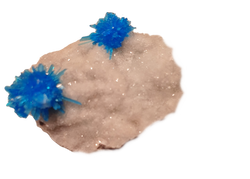
Celestite / Celestine


A Lovely Sized Celestite Geode
Another Spectacular Piece of a Celestite Geode
Celestite is a sky blue mineral treasure that is primarily composed of strontium sulfate. It mainly forms in sedimentary environments like ancient oceans, lagoons and salt flats, when groundwater moves through sulfate rich layers and precipitates crystals over thousands of years. Celestite is the world's primary source of Strontium, which is used in the production of fireworks, flares, tracer ammunition and scientific instruments.
* These specimens were found in Madagascar
Beautiful Apophyllite


Apophyllite with Stilbite
Like many crystal types, Apophyllite originates in volcanic environments and is formed in a low temperature hydrothermal process, when mineral rich hydrothermal fluids and groundwater flow through volcanic bubbles and cavities.
* Found in India

Fluorite Crystals


Magical, Cubic and Octohedral Fluorite Crystals
Fluorite is a highly prized mineral that can glow vividly under ultraviolet light. It can be found in Australia, China, Mexico, USA, Canada and South Africa. Like many crystals, it forms, mainly, when hot, mineral rich water travels though fractures and cavities in rock and cools. Dissolved calcium and fluorine then bond together to grow into crystals.
* These specimens were mostly found in China
Green Fluorite

Another Lovely Cluster of Large Green Cubic Fluorite Crystals from China

THE MAGNIFICENT METAL CUBIC CRYSTALS OF NAVAJUN PYRITE


Cubic and Octahedral Pyrite Crystals
Cubic Pyrite is probably my favorite Crystal of all! It grows into, impossibly perfect, natural metallic cubes. They form when hot, mineral rich water, saturated with dissolved sulphur and iron, travels through fractures and cavities in rock. The sulphur and iron bond together when the temperature and pressure remain consistent for long periods.

Calcite Crystal
Aquamarine Crystal


A Lovely Clear Optical Calcite Crystal
A common carbonate mineral that is the primary component of limestone and marble. It comes in a variety of crystal shapes, but the crystal in our collection looks like a squashed or tilted cube with slanted interior angles. If this crystal breaks it will exhibit perfect cleavage and break down into smaller versions of the original.
A Gorgeous Aquamarine Crystal
Aquamarine is a light blue to light green variety of the beryl mineral family. Traces of iron give the crystal its blue-green hue. This specimen is Aquamarine on Albite.
* Found in the Shigar Valley, Skardu, Pakistan

Tourmaline is found all over the world. It forms in granite and metamorphic rocks, and is a mineral that occurs in almost every colour of the rainbow. Like quartz it exhibits unique piezoelectric and pyroelectric properties, meaning it generates an electric charge when squeezed or heated.
A Black Tourmaline Crystal
Black Tourmaline Crystal
Pyrolusite Crystals
Garnet Crystal

Pyrolusite Metallic Crystals
This is a lustrous cluster of radiating silver sprays of Pyrolusite. Pyrolusite is a mineral consisting of manganese dioxide.
* Found in Morocco, Northern

A Large, Rough Garnet Crystal
* Found in Australia
THE LARGEST CRYSTALS IN THE WORLD!
The spectacular Cave Crystals of Naica,Mexico
The Cave has featured in many documentaries since its discovery in 2000, including Naica : Beyond the Crystal Cave ( The Discovery Channel 2011 ), Angry Planet Season 3, The History Channel Season 2.
* These pictures are absolutely genuine! They were taken by a team of scientists that explored the cave in 2006


The Cave of the Crystals, (Cueva de los Cristales), is a cave connected to the Naica lead, zinc and silver mine, in Naica, Chihuahua, Mexico. Discovered in 2000 and about 109 metres long, the cave contains some of the largest natural crystals ever found : giant selenite crystals ( Calcium Sulphate - gypsum), with beams reaching up to 12 metres (39 feet) long and weighing 55 ton. The crystals grew to their massive size across more than a million years, in hot, mineral rich water. The cave that contains them is extremely hot with high humidity and multiple exploration teams have discovered that without proper protection, humans can only endure approximately ten minutes of exposure at a time. In 2015 the cave was allowed to reflood to protect the crystals.
There are many videos documenting different research teams exploring of the cavern - the link to one of these is here : https://www.youtube.com/watch?v=S_K-olC2gdU
OTHER INTERESTING ROCKS AND MINERALS IN THE COLLECTION


Opal
Queensland Boulder Opal.
The Beautiful Blues and Greens of Australian Opal.

Obsidian
Obsidian is a naturally occurring volcanic glass, formed when silica-rich lava cools so rapidly, that mineral crystals cannot form. It was used by early humans and later civilisations to make cutting tools, weapons, and ceremonial objects.

Galena
Galena is the natural mineral form of lead. It is 84% lead and 14% sulphur. It also often contains silver.
In Ancient Egypt, it was applied around the eyes to reduce the glare of the desert sun. In other parts of the world, galena was used by indigenous people as an ingredient in paints and cosmetics and was widely traded.
*This piece was mined in Broken Hill, Australia.


OBJECTS FROM SPACE
And Artifacts Related to Space


METEORITES
A meteorite is a rock from space. But its story is even more epic than that! It came from the asteroid belt between Mars and Jupiter. It is a piece of a destroyed planet, asteroid or comet. It is between 4.5 to 4.8 billion year old..... and that makes it the oldest rock in the solar system - older than the Earth! For billions of years it sat quietly in the asteroid belt until a another large space rock collided with it and sent it on a silent, 500 million kilometre journey through space to a fiery and explosive impact on the Earth. Most meteorites travel to Earth from the asteroid belt, however, rare rocks, smashed from the surface of the Moon and Mars, have also been discovered on Earth and feature in the Stones, Bones and Stars Museum.
Meteorites are classified into 3 types based on composition : Stony, Iron and Stony Iron. Stony meteorites are the most common and resemble Earth rocks. Iron meteorites are composed almost entirely of iron and nickel and are pieces of the core of a shattered planet or asteroid. Stony -Iron Meteorites are a rare mix of both. The Stones, Bones and Stars Museum has specimens of each type of meteorite.
A space rock is called a meteoroid as it travels through space, a meteor as it makes its fiery journey through the Earth's atmosphere and then a meteorite when it smashes onto the Earth's surface.


A Shooting Star!
Of course, a meteor is also known by another name as it makes its fiery journey through the Earth's atmosphere ...........
Stony Meteorites
Most stony meteorites are non-metallic space rocks called 'chondrites' which formed about 4.56 billion years ago. They usually originate from asteroids or asteroid accretions that were too small to undergo the incredible heating and melting process experienced by larger asteroids and planetesimals as they struggled to become planets. Because their parent asteroid stayed cool and didn't melt, chondrite meteorites consist of material that is still, almost exactly as it was at the birth of our solar system.They comprise 86% of all meteorites that land on Earth.


NWA 869 L3-6 Meteorite
Classification : Ordinary Chondrite L3-6, W 1, S3
Fragmented Breccia
Size : 15cm
Weight : 2.56 kg
Date of Find : 2002
Source : Obtained from the collection of Norbert Kammel : Rocks on Fire
A lovely, big, unusual and famous stony Chondrite meteorite that was recovered from the Sahara Desert in Northern Africa in 2002. It is almost completely intact and It has a beautiful dark, shiny blast crust combined with a desert sheen. NWA 869 has a highly unusual classification....L3-6, meaning it, confusingly, exhibits features of different meteorite types. It is speculated that many other meteorites may have landed on NWA 869's parent asteroid, creating a new mixture of materials on its surface. So NWA 869 is possibly a collection of many different meteorites in one! NWA 869 contains chondrules (small round mineral grains) that are some of the oldest solid material in the Solar System - they have not changed for 4.55 billion years - making them slightly older than the Earth!
Iron Meteorites
Iron and Nickel meteorites are metallic space rocks that were once part of the solid metal cores of large asteroids, planetesimals and possibly even planets that collided with other space objects and broke apart. These asteroids, planetesimals and planets became so hot during their formation that they completely melted, causing the heavy iron and nickel in them to sink to the centre, eventually creating a large solid metal core in each. Iron and nickel meteorites comprise only 4% of all meteorites that land on Earth.
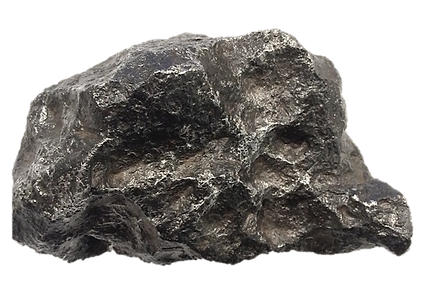
Campo Del Cielo Meteorites
Campo Del Cielo Meteorite
"Field of Heaven"
Composition : Iron and Nickel
A lovely big chunk of one of the most famous meteorites to ever strike the Earth.
Age : Approximately 4.5 billion years old.
Fall: The meteorite broke apart and smashed into Argentina about 4000 to 5000 years ago. It was discovered by indigenous people long before Spanish soldiers collected pieces in the 1576's.
* Found in Argentina, Sth America
Two more pieces of the Campo Del Cielo Meteorite that broke apart in the atmosphere and struck the Earth as small separate meteorites. These pieces have had their blast crust stripped by acid, which shows off their spectacularly melted textures and iron and nickel composition to maximum effect.
* Found in Argentina, Sth America


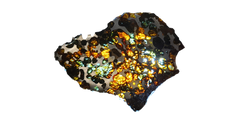
Sericho Pallasite Meteorite Half
-
This is half of a very rare and beautiful Sericho Pallasite stony-iron meteorite.
-
Age : Approximately 4.5 billion years old
-
It is part of the metal core of an asteroid.
-
Composition : olivine / peridot Crystals suspended in an Iron and Nickel matrix
* Found in Sericho, Kenya, East Africa 2016
Sericho Pallasite Meteorite Slice
-
Part of the core of an asteroid
-
A slice of a rare Sericho Pallasite stony-iron meteorite, preserved in resin. It features a wonderful pastiche of olivine / peridot crystals, suspended in an iron and nickel matrix.
* Found in Sericho, Kenya, East Africa 2016
Sikhote Alin Meteorite
-
Composition : Iron and Nickel 11AB
-
A piece of another famous meteorite which exploded over the Sikhote-Alin Mountains in Russia on Feb 12, 1947. At an altitude of about 5km, the 100 ton main piece violently fragmented. This specimen is a chunk of that fragmentation.
* Fall occurred 10.38am, 2/12/1947 in the Sikhote Alin Mountains, Russia.
Medium Octahedrite

Gibeon Meteorite Slice
Composition : Iron and Nickel
Age : Radiometric dating indicates that the metal matrix of this meteorite was formed before the Earth was fully formed - more than 4.5 billion years ago!
This piece features exquisite natural patterns etched into the metal matrix, called Widmanstatten Patterns.

NWA Stony Meteorite Slice

Mundrabilla Meteorite
Composition : Iron and Nickel
Age : 4.5-4.6 billion years old
Fall : about 1 billion years ago
* Found in Nullabor Plain Western Australia 1966
Widmanstatten Patterns
Unclassified Chondrite
* Found in Morocco, Africa 2004
These striking crisscrossing bands only form when molten metal cools at an ultra-slow rate of about 1 degree Celsius per million years deep inside an asteroid.
* Found in Gibeon, Namibia, South West Africa in 1856


It is illegal for private citizens to own, buy or sell moonrocks that were collected and brought back to Earth by astronauts from the Apollo 11, 12, 14, 15, 16 and 17 missions to the moon [ 1969 to 1972 ]. All lunar rocks are legally owned by the US Government, although it has gifted, donated and loaned some specimens to other governments, major museums and research institutions. So how on Earth ( or off Earth! ) have moonrocks made their way into the Stones, Bones and Stars Collection?

The answer is that the moonrocks in the Stones, Bones and Stars Collection arrived on Earth via a completely different process :
Lunar Meteorites!
Lunar Meteorites
Lunar Meteorites are exceptionally rare. They are rocks that have been blasted off the Moon's surface by the impact of asteroids and meteoroids. Because the Moon has no atmosphere, meteoroids that strike its surface hit with devastating speed and force and the impact debris has very little to stop it ascending into space. Some of these rocks orbit the Earth and are eventually pulled through the atmosphere to the surface by gravity. Scientists can confirm that a meteorite/rock is from the Moon by comparing its mineral and chemical composition with that of Moon rocks brought back by Apollo mission astronauts.

MOONROCKS

The Stones, Bones and Stars Mini Museum has 4 Moonrocks / Lunar Meteorites in its collection; here are 3 of them.
LUNAR METEORITES

Bechar 003 Lunar Meteorite
Officially recorded in the Meteoritical Bulletin Database / Lunar and Planetary Institute, Houston Texas
-
One of only 780 Lunar ( Moon ) Meteorites officially recorded.
-
Type : Feldspathic Breccia from the highlands of the moon.


NWA 13788 Lunar Meteorite Polished End Cut
Officially recorded in the Meteoritical Bulletin Database /
Lunar and Planetary Institute, Houston Texas
-
Type : Lunar Melt Breccia.

NWA 11273 Lunar Meteorite
Officially recorded in the Meteoritical
Bulletin Database / Lunar and Planetary Institute, Houston Texas
-
Type : Feldspathic Breccia.

* Found in Bechar, Algeria in 2022
* Found in Ouargla, Algeria in Dec 2020
* Found in North West Africa 2017
-
Very rare - there have only been 3 found of this type of lunar meteorite
MARS ROCKS / MARTIAN METEORITES


Mars Rock Slice :
Martian Meteorite NWA 13366
Officially recorded in the Meteoritical Bulletin
Database / Lunar and Planetary Institute, Houston Texas
Meteorites from Mars are so rare ( and expensive ) that we could only obtain this very thin slice of specimen NWA 13366 ( and the sample opposite ) for the SB&S Collection.
This slice is composed of Peridotitic Shergottite - a type of igneous rock formed through cooling magma or lava.
* Found in Algeria 2019
Meteorites from Mars are incredibly rare - they make up less than 0.5% of all known meteorites on Earth. Only 358 have been discovered so far. They were blasted into space when asteroids smashed into the surface of Mars and they eventually travelled around 225 million km to Earth.
Scientists can verify that a rock is from Mars by analysing the chemistry and elements contained in a tiny amount of gas trapped inside the rock and matching it with the Martian atmosphere information provided by NASA rovers on Mars.
A very thin slice of another rare Martian Meteorite, NWA 12269 ( like the sample opposite NWA 13366 ).
This slice is also composed of Shergottite, an igneous rock blasted off the surface of Mars by a massive asteroid millions of years ago.

Mars Rock Slice :
Martian Meteorite NWA 12269
Officially recorded in the Meteoritical Bulletin
Database / Lunar and Planetary Institute, Houston Texas
* Found in the Sahara desert, Nth Africa 2018
TEKTITES : VERY NEARLY Objects from Space


* These are 'Indochintites', tektites that were found mostly in the Indonesian area of the Australasian 'strewnfield', a tektite area created by a massive meteorite impact approximately 788,000 years ago.
Tektites are strange looking forms of naturally melted silica glass, whose origins have mystified humans since the first recorded discovery in China in 950AD. However, human use of tektites as implements and ornaments stretches back to prehistoric times.
While no fall has ever been observed, tektites are now believed to have been created when large meteorites and asteroids impacted silica rich soil, instantly melting it. This melted silica was then, at the same time, ejected, or, more accurately, splashed, up into our atmosphere, in ball or droplet shapes, until gravity forced them back to the surface of the Earth.
They often acquired aerodynamic shapes which were determined by a combination of both ejection (on the way up) and atmospheric re-entry (on the way down). Their name comes from the Greek word 'Tektos", meaning 'molten'. Tektites are found in select locations across the globe, referred to as strewn fields. There are four universally accepted strewn fields, with a fifth that was recently described. These fields are, from largest to smallest diameter: the Australasian, the North American, the Ivory Coast, the Central European, and the Central American.
SPACE RELATED 'ARTIFACTS'* ( * Objects Created and Used by Humans )
A Large Piece of NASA Spacesuit Material


A piece of protective foil from the Apollo 11 Command Module / Capsule "Columbia" - removed after it returned to Earth from the Moon.
A picture of Buzz Aldrin on the surface of the moon, wearing a spacesuit made of this material.
This material is a piece of NASA spacesuit material donated by Dan Klopp, Director, Space Systems Division @ ILC Dover ( who constructs the spacesuits ). The material comprises 11 layers, as can be seen in the picture, to protect astronauts throughout spaceflights, including a kevlar-like outer shell to protect from micro meteor impacts during spacewalks.
In 1969, three NASA astronauts travelled from the Earth to the Moon and walked upon the Moon's surface, as part of the Apollo 11 Mission. The mission's Command Module (Capsule), Columbia, pictured above, was wrapped in multiple layers of Kapton foil to protect the astronauts and electronic systems within from deep space radiation and extreme temperature fluctuations. When the capsule and the astronauts returned to Earth, the foil was stripped away by engineers who were given permission to keep some portions of it. This is a tiny piece of that foil.
FOSSILS
Dinosaur : ( Spinosaurus . Triceratops. Carcharadontosaurus . T Rex . Saltasaurus . Hadrosaur ) . Woolly Mammoth . Flying and Marine Reptiles : ( Pterosaur . Megalodon . Mosasaur . Plesiosaur ) . Trilobite . Ammonite . Orthoseras . Fish ( Phareodus ) . Insects . Plants and Trees


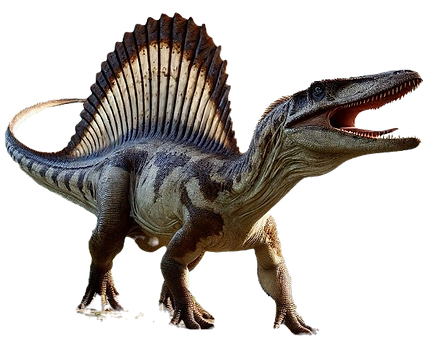
DINOSAUR FOSSILS
SPINOSAURUS


A 17cm beast of a Spinosaurus tooth - one of the biggest we've ever seen - with the root attached!
* Found in Oued Zem, Morocco
Spinosaurus was the world's largest known carnivorous dinosaur, measuring about 13.4 metres in length and weighing seven tons. It lived in Northern Africa 112 to 72 million years ago.
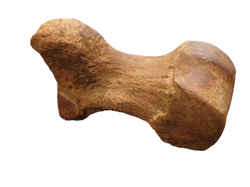
Spinosaurus Dinosaur Bone.
Spinosaurus Maroccanus
97 to 122 million years old
. * Found in Tafraoute Morocco, Nth Africa
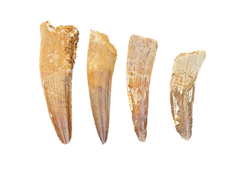
More Spinosaurus Dinosaur Teeth.
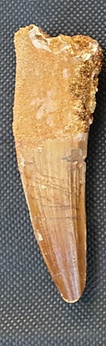


About Spinosaurus Teeth.
Many dinosaurs replaced their teeth throughout their lives, however, Spinosaurus grew and replaced its teeth at a remarkably fast rate, replacing individual teeth every 60 to 68 days! ( T Rex took over 2 years to replace a tooth ). This rapid, continuous replacement is the reason why Spinosaurus teeth are some of the most abundant fossils found in places like Morroco, Nth Africa. Spinosaurus teeth are conically shaped, smooth, unserrated and have long grooves, ( 'flutes' or 'striations' ) running vertically along the teeth. This allowed them to function like spears to pierce and immobilise marine prey, unlike the serrated knife-like teeth of other meat eating dinosaurs.
. * Found in Morocco, Nth Africa
TRICERATOPS


* From Hell Creek Formation , Sth Dakota USA
Triceratops Rib Bones
Cretaceous Period : 66 - 68 million years old
Triceratops Frill Segment
Cretaceous Period : 66 - 68 million years old

Triceratops Tooth
Late Cretaceous Period : 66 - 68 million years old.


* Found in Lance Creek Formation, Wyoming USA
* Found in the Hell Creek Formation, Eastern Montana, USA
CARCHARADONTOSAURUS


Carcharadontosaurus Saharicus Dinosaur Tooth
A huge therapod dinosaur - possibly bigger than T Rex.
Tooth is 94 -100 million years old
* Found near Taouz, Sahara, Morocco, Nth Africa
TYRANNOSAURUS REX


Tyrannosaurus Rex Partial Dinosaur Tooth
Full Tyrannosaurus Rex teeth are so expensive that we could only afford part of a tooth for the collection - but even that small part looks cool and deadly. Note the serrations, for better slicing and dicing of prey!


HADROSAUR DINOSAURS
Hadrosaurs
The " Duckbilled" Dinosaurs
Lived 73 - 66 million years ago - Cretaceous Period
One of the last groups of dinosaurs to exist.
Dinosaur Skin Impressions
About 80 million years ago, two dinosaurs died at two different times in Cretaceous Montana USA. As they died, they fell onto clay, mud or sand and their weight pressed their skin into the ground and left spectacular impressions of their vaguely octagonal scales. These impressions were then filled in and covered over by more layers of sand, clay, mud or soil which, over many millions of years, were compressed and transformed into rock, preserving the impressions. When the rock weathered or was cracked open, the spectacular skin and scale impressions below were revealed.


Hadrosaur Dinosaur Skin Impression 1
From 66 to 86 million years old - the Cretaceous Period
* Found in the Hell Creek Formation, Montana, USA
Hadrosaur Dinosaur Skin Impression 2
66 - 86 million years old
Found with eggshell fragments!
* Found in the Hell Creek Formation, Montana, USA
Edmontosaurus Dinosaur Bone
66 to 86 million years old - Cretaceous Period
* Found in the Hell Creek Formation, Montana, USA

DINOSAUR FOOTPRINTS PRESERVED IN ROCK


Claw impression
Beautiful Raised Anomoepus Dinosaur Footprints
-
A raised Anomoepus Dinosaur footprint rare in its size, made by a small, herbivorous dinosaur.
-
This dino print is called a "Natural Cast" formed when the *'true track' is filled in by mud, clay or sand which hardens into rock over millions of years.
-
210 million years years old - Jurassic period.
* Found in Connecticut River Valley near Middletown Connecticut USA.


Head Curator of Canada's SkullStore and Prehistoria Natural History Centre, Ben Lovatt, displaying this impressive dinosaur footprint, before it became part of the "Stones, Bones and Stars" Collection.
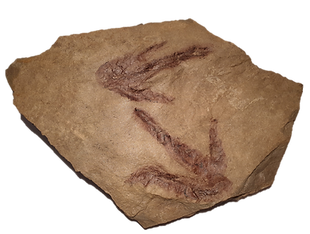

Claw impressions
Smaller Grallator Therapod ( Raptor ) Dinosaur Footprints
-
'True Track' ( original tracks) dinosaur footprints, made by a small, carnivorous raptor-like dinosaur.
-
These dino prints are called "True Tracks" - the direct original depressions left behind by the dinosaur's foot.
HOW POSITIVE RELIEF ( Natural Cast ) AND NEGATIVE RELIEF
( True Cast ) DINOSAUR FOOTPRINTS FORM
1. Dinosaur walks through sand, mud or clay.
2. Dinosaur leaves a footprint called a 'True Track".
3. Sand / mud fill the true track and over millions of years is compressed and transformed into rock.

5. Original 'True Track' now set in rock exposed

5

6
4. Top section
( Natural Cast ) separates from bottom section
( True Track ) either naturally or by human action.
6. 'Natural Cast' is also exposed


DINOSAUR EGG SHELL FRAGMENTS


Saltasaurus Dinosaur Egg Shell Fragments.
* Found in Patagonia, Argentina, South America


* Sadly this complete Saltasaurus egg is not in the collection. It's simple here to show what a complete Saltasaurus egg looked like.
Polished Agatised Dinosaur Bone.


A dinosaur bone specimen ( unknown species ), whose organic material has been replaced by agate over many millions of years and polished to enhance and display its fossilised cell structure.
Age : Late Jurassic
Found in the Morrison Formation, Red Rock, Near Salt Lake City, Utah USA

USA
Coprolite : Fossilised Dinosaur Poo
A Preserved Slice of the K-T ( K-Pg ) Dinosaur Extinction Layer

The KT [ K-pg ] Layer or Boundary is a 66 million year old thin layer of clay, found all over the world, that marks the precise moment when dinosaurs and 80% of other animal species on the Earth were wiped out!
This mass extinction event was most probably caused by a massive asteroid or comet ( estimated to have been 10 to 15 km wide! ) that slammed into the Earth near Mexico, leaving a huge crater known as the Chicxulub Crater .
The Clay of the KY [ K-pg ] layer is filled with ash, micrometeorites and iridium, which is rare on Earth, but abundant in asteroids.
This sample of the KY [ K-pg ] layer was collected from the Lance Creek Formation in Wyoming, USA.

PREHISTORIC REPTILES [ Not Dinosaurs ]
Pterosaur

The Siroccopteryx Moroccoensis Pterosaur was a flying reptile, not a dinosaur, although it lived in the same era as dinosaurs.
Approximately 66 to 220 million years old - dating to the Mid Cretaceous Period.
*Found in Kem Kem Morocco, Nth Africa

Pterosaur ( Siroccopteryx Moroccoensis ) Tooth


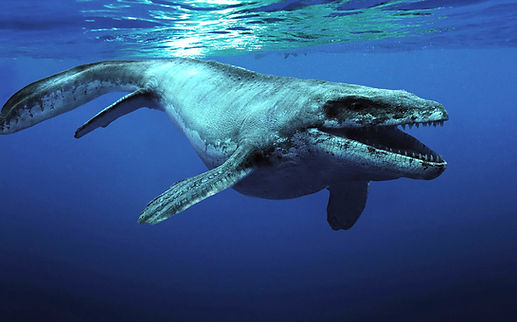


Mosasaurus
Mosasaurus Teeth
66 to 82 million years old - Late Cretaceous Period
Although an aquatic reptile rather than a dinosaur, Mosasaurus was, nevertheless an awesome predator, the largest estimated to have been about 12 to metres in length and weighing 10 tons. Mosasurus fossils have been found in North and South America, Europe, Africa, Asia and Antarctica.
* Found in Khouribga, Morocco, Nth Africa


Plesiosaur
Plesiosaurus.
A large ( 3 metres long ) marine, sauropterygian reptile that lived during the Early Jurassic.The first complete skeleton of Plesiosaurus was discovered in December 1823, by celebrated early paleontologist and fossil hunter, Mary Anning, in Early Jurassic-age rocks near Lyme Regis in Dorset, UK.
155 million years old
From the Kimmeridgian /Upper Jurassic Epoch
* Found in Weymouth, Dorset UK
Plesiosaur Bone
(Perhaps Paddle Bone)

WOOLLY MAMMOTH FOSSILS

Woolly Mammoth Tooth
40,000 years old - Late Pleistocene
Lower Jaw molar
*Found in the North Sea - between Britain and Europe


Woolly Mammoth Outer Tusk Section
Woolly Mammoth Tusk Section
Part of the inner core of the tusk
20,000 - 40,000 years old
* Dredged from the North Sea
Part of the outer layer of a mammoth tusk.
Pliestocene Epoch
* Found in The Doggerbanks in The North Sea, Europe

Woolly Mammoth Toe Bone
40,000 years old - Late Pleistocene
Each toe comprised 2 or 3 large bones.
*Found in Siberia, Russia 2020

Woolly Mammoth Hair/ Fur
20,000 - 40,000 years old - Pleistocene
* Found in Yakutia, Siberia Russia

Woolly Mammoth Skin
10,000 - 40,000 years old - Pleistocene
* Found in Siberia Russia
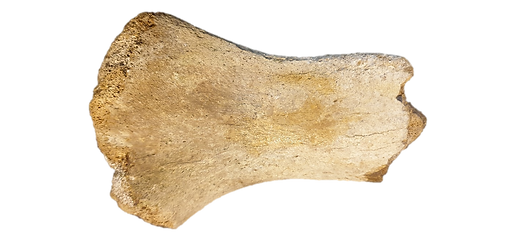
Woolly Mammoth Bone
40,000 years old - Late Pleistocene
*Found in Siberia, Russia
MEGALODON FOSSILS


A Large, complete Megalodon Tooth


Some partial Megalodon Teeth
2 -10 million years old
* Found in Sth Carolina River USA
* Found in Cooper River USA


TRILOBITE FOSSILS
Trilobites were marine arthropods who were one of the most successful of all early animals. They existed in the Earth's early oceans for an astonishing 270 million years ( dinosaurs could only manage 165 million ), from 520 million years ago. Almost 22,000 different species of Trilobite have been identified. Remarkably, Trilobites had an exoskeleton made from mineral calcite and organic chitin - even their eyes were were composed of calcite crystals! During their lifetime they periodically shed this exoskeleton in order to grow.


Paradoxides Trilobite
500 Million Years Old
* Found in Morocco
Metacanthina Issoumourensis
Devonian Trilobite
* Found in Mt Issoumour, Alnif Morocco
Hamar Laghdad Limestone
400 Million Years Old


Calymene Trilobite
* Found in Morocco
CEPHALOPODS ( MARINE MOLLUSCS )

Cephalopods are highly intelligent, organised, ocean dwelling, carnivorous marine molluscs. Their name literally means 'head foot' because they have their foot or tentacles connected to their head, not their body. Living members of this group include the octopus, cuttlefish, squid and nautilus.
Some extinct Cephalopods like Ammonites ( which lived 240 to 66 million years ago ) and Orthoceras
( which lived 500 to 200 million years ago), lived inside a shell, had tentacles that they could use to grab food and used squirting water - jet propulsion, to move. Cephalopod fossils mainly comprise shells as their soft bodies and tentacles would decay too quickly after death.
Fossilised Cephalopod shells that feature in our collection are :

AMMONITE FOSSILS


A Magnicent Kranosphinctes Ammonite
160 million years old
* Found in Sakahara Madagascar
Assorted Ammonite Fossils


An wonderful Ammonite, cut in half, whose chambers have filled with calcite crystals, laid down across millions of years


A lovely positive and negative Ammonite fossil from the UK

Fossilised Orthoceras Shell
Lived during the Upper Devonian period around 370 million years ago.
Like other cephalopods, it lived inside of its shell, had tentacles it could use to grab food, and used jet propulsion, squirting water to move.
* Found in the Atlas Mountains of Morocco, Nth Africa


FISH FOSSILS


Phareodus Fish Fossil
50 million years old - Eocene epoch
An huge apex predator with a vicious set of teeth and a highly prized specimen for collectors.
* Found in the Green River Formation, Wyoming USA
INSECT FOSSILS
BIRD FOSSILS

Sandflies in Amber
Remember the classic Jurassic Park movie moment when the mosquito in amber was used to extract dino DNA? Here's our own version!

Diptera Fly
Dates to Eocene Period - 56 to 34 million years ago
Found in the Green River Formation, Utah USA

Fossilised Bird feather
Dates to Eocene Period - 56 to 34 million years ago
Found in the Green River Formation, Garfield, Colorado USA
TREE / PLANT FOSSILS


Petrified Wood


Fossil Seed Fern
Carboniferous Period
A Pecopteris or Crenulopteris fern fossil
From the Carboniferous period, roughly 300 million years old
It is preserved within an ironstone nodule
* Found in the Carbondale Formation, Pennsylvanian, Upper Carboniferous, Coal City, Illinois, USA
ANCIENT CULTURES


* For thematic purposes only. Tutankhamun's funerary mask is, sadly, not part of the collection!

ANCIENT EGYPT

USHABTI FUNERARY STATUES
Ushabtis ( Other names : Ushebti / shabti / shawabty) were small figurines or statues that were placed in the tombs and graves of ancient Egyptians.They frequently carried a hoe on their shoulder and a basket on their backs and were believed to come to life and perform any manual labor or agricultural tasks required of the deceased in the afterlife.
Ushabtis could be made of wood, stone, clay or more commonly, faience (a quartz-based ceramic that were often glazed in shades of blue or green, symbolizing rebirth). They were among the most common artifacts buried with Egyptians of all social classes, however the greater the status or wealth of the deceased, the greater the number of ushabtis that were placed with them.

Ushabti Funerary Statue
For
Unknown
Late Kingdom / Possibly 30th Dynasty
Dates to approximately 500 BC.
Composition : Faience
Ushabti Funerary Statue
For
Commander of the Army /General, Hor Ahmose
Late Kingdom / Possibly 30th Dynasty .
Dates to approximately 500 BC.

Composition : Faience


Ushabti Funerary Statue
For
Unknown
Late to Ptolemaic period
Dates to 600 to 100BC.
Composition : Faience
* Found Lower Delta, Egypt
Ushabti Funerary Statue
for Unknown
Late to Ptolemaic period
Dates to 600 to 100BC.
Composition : Faience
* Found Lower Delta, Egypt

Ushabti Funerary Statue
for Overseer of the Army / General, Hor Ahmose
The highlight of the modest Stones, Bones and Stars collection of Ancient Egyptian artifacts is this Ushabti statue for General Hor Ahmose, Overseer of the Army / General. The hieroglyphics which have been interpreted thus far are "The Illuminated, the Osiris, Overseer of the Army, Hor Ahmose" and a reference to his mother, "Nebet Per Kek - the Lady of the House of Kek". Any assistance with translation of the rest of the text would be greatly appreciated!.
A Carved Royal Scarab Bearing the Royal Name of Warrior Pharaoh, Thutmose 111
Different views of the Scarab.

A clay impression of the scarab's hieroglyphics.


The Scarab's Hieroglyphics.

A statue of Thutmose 111 in the Luxor Museum.
How the Scarab may have looked mounted as a ring.
*Sadly, we don't have the golden mount in the collection!
From the reign of Pharaoh Thutmose 111 - (18th Dynasty). 54 regnal years: 1479 – 1425 BC
Features the pharaonic honeybee symbol and the name and royal cartouche of Pharaoh Thutmosis the 3rd. The inscription reads : "King of Upper and Lower Egypt, Lord of the two lands, Son of Re" with the nomen of the Pharaoh, Thotmosis the 3rd, within a cartouche ( Men-Khepre-Re ).
* Found in Karnak, Egypt
Bronze Inlay Eyes and Eyebrow from a Wooden, Outer Anthropoid Sarcophagus
Date to : New Kingdom : 1570 -1070 BC
Sadly, these 3 bronze inlay eye pieces are all that remains of an anthropoid sarcophagus ( such as those pictured ) that either deteriorated naturally in its tomb or was damaged by human intervention, during the last 3000 years. The original calcite and gemstone eyes are missing ( replaced by clay ) but there are still traces of crystal calcite on the bronze.


These Sarcophagus images are for illustration purposes only - unfortunately, the artifacts themelves are not part of our collection!


* Found in Sakkara, Abusir Area, Egypt
Anthropoid Sarcophagus Decoration


A Miniature Votive Vessel
Dates to : New Kingdom : 1570 -1070 BC
A miniature terracotta clay votive vessel. This type of urn, sometimes containing perfumes and oils, was frequently placed in tombs or temples as an offering to gods or to provide sustenance for the deceased in the afterlife.
* Found in Sakkara, Egypt

Linen Mummy Wrapping
Dates to the Third Intermediate Period 900 - 700 BC
A large piece of linen from the wrappings of an Egyptian mummy with brown colouration from original oils, resins and bitumen used in the mummification process.
Funereal / Ceremonial Urn / Vessel
Mummy Wrapping

Viking Arrowhead
This is a 4.2 inch Viking socketed arrowhead. It has a tapered, side butted seam socket and a slender point, that is thickened in the middle, for penetration of the leather armour of enemies.
Dates from 856 to 1067 AD

Viking Beard Ring
This is a gold plated, bronze, Viking beard ring, worn as depicted in the picture. The use of beard rings by Vikings is well documented, although few genuine examples survive.
Dates from 856 to 1067 AD

VIKINGS


* I've indulgently used a pic of my lost brother Ray ( Legs ) for the Viking image - he would have made a good Viking warrior, I think and, according to Ancestry DNA, we do have a little Viking DNA in us!
EARLY HUMANS
Early Human, Palaeolithic Acheulean Hand Axe


These Homo Ergaster skull images are for illustration purposes only - unfortunately the specimens themselves are not part of our collection!


Palaeolithic Acheulean Hand Axe From Homo Ergaster
This massive Lower Palaeolithic hand axe was one of the first, scientifically documented tools made by primitive humans. It was crafted and shaped into a cutting and hammering tool between 900,000 and 1.5 million years ago by an early type of human called Homo Ergaster, in Northern Africa. Homo Ergaster was the first of our ancestors to possess modern human-like body proportions : they were taller, had longer legs, a flatter face with a projecting nose and larger brains. This increased brain capacity enabled them to develop more advanced, symmetrical and sharper stone tools such as this Acheulean handaxe. This new technology was an improvement on the very simple and crude pebble and flake tools that earlier ancestors had been using for about one million years. Microscopic examination has shown this tool was mainly used on meat, bone, animal hides and wood.
* This artifact was surface-collected at an exposed Acheulean tool work site in the Sahara Desert Region of Northern Africa
RARE BOOKS AND NEWSPAPERS

An Edition of Australia's First Newspaper : The Sydney Gazette and New South Wales Advertiser, Printed on Friday May 18, 1827.
The Sydney Gazette and New South Wales Advertiser was the first newspaper to be published in Australia, in 1803.
It was printed on the first printing press to operate in Australia, an old wooden and iron printing press that had arrived in Sydney with the First Fleet in 1788.
This edition, printed on Friday May 18, 1827, provides a snapshot of early Australian life and features tales of escaped convicts, accounts of injustice to indigenous people, reports of colonial courtroom dramas, quaint advertisements and very personal notices.


The Oldest Book In The Collection - Nearly 450 Year Old
"JUSTINIAN PANDECTAE. SACRATISSIMI PRINCIPIS IVSTINIANI."
'The Digest or Compendium of the Most sacred Prince Or the Most August Emperor, Justinian' ( the 6th Century Byzantine Emperor ).
A Massive Collection of Legal Writings.
Published in 1580.


Justinian Pandectae Sacratissimi Principis Ivstiniani
Compiled, organised and and edited by Julio Pace, a celebrated Italian legal scholar and philosopher.
Printed and published in 1580 by Eustache / Eustathius Vignon, a 16th century French Protestant publisher and printer who operated a very famous print shop in Geneva.
This is book made a major contribution to European legal history - Roman Emperor Justinian's monumental 6th Century codification of Roman law.
A First Edition of Charles Dickens' Bleak House 1853


A First Edition of Bleak House
This is the first bound edition of Charles Dickens' classic novel Bleak House. It was published in London, England in 1853.
By Charles Dickens
MISCELLANEOUS OBJECTS OF INTEREST

Fulgerite
Fulgerite (from Latin fulgur, meaning "lightning"), is another naturally occurring glass and like other natural glasses with an amazing creation story.
Fulgurite is a natural, hollow glass tube or clump formed when a powerful lightning strike penetrates the ground, vaporizes water and organic matter while instantaneously melting silica rich rock and soil into a liquid state. The molten material rapidly cools and solidifies into a glassy state, leaving behind a brittle, tube-like crust of fused sand or rock. Fulgerite is often referred to as "fossilized lightning".


A Piece of the Berlin Wall


Chiselled from the Western side of the notorious BerIin Wall in June 1990
* From East Berlin, Germany
Greg standing on the East side of the BerIin Wall, near where he obtained this piece.